Salon Timsina
Data analyst & backend engineer,
with a pull toward neurotech.
Computational mathematics student building things across data, backend systems, and computational neurotech.
I'm studying computational mathematics at Kathmandu University, mostly working through numerical methods, optimization, and algorithm design. Outside of coursework I build backend systems and data pipelines, and lately I've been spending a lot of time reading into neuroscience and neurotech — how the brain encodes and transmits signals, and where that overlaps with computation.

Khalto — DeerHack 2026
A crowdsourced system for mapping road hazards using nothing but a phone's sensors — combining signal processing, anomaly classification, and geospatial analysis to flag potholes and rough patches in real time. Won the Interactive Technology (IoT) track.
F1 Tire Degradation Prediction
A regression model that estimates Formula 1 tire wear from race telemetry and environmental conditions, using feature engineering and ensemble methods — including Random Forest — to capture how degradation shifts over a race.
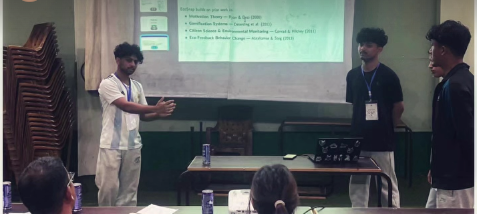
EcoSnap
A gamified waste-sorting app built at the Prakriti Hackathon — identifies waste type from a photo and gives disposal or recycling guidance on the spot, aimed at nudging better sorting habits through quick feedback.
CtxGen
A Go-based static analysis tool that reads a codebase and produces a compact, structured summary of its architecture, dependencies, and symbols — built to give language models useful repository context without the token cost of the whole repo.
Expository Study on Thalamocortical Seizure Modeling
A working-through of a thalamocortical model for epileptic seizures — examining EEG-based seizure dynamics via computational neural mass modeling, and what the mathematical framework means physiologically.
Protein Structure Analysis using Topological Data Analysis
Uses persistent homology and a topological importance factor on alpha-carbon protein structures to identify which regions are most sensitive to mutation, based purely on structural shape.